Shop Sign Board Rules in Chennai: What to Check Before You Order
A sign board that has to come down after it is installed is the most expensive board there is — you pay for it twice and lose the frontage in between. Almost every case we have seen was avoidable with a phone call made before fabrication started. Here is what to check.
Please read this as a checklist, not as legal advice. Signage rules in Tamil Nadu differ between the Greater Chennai Corporation and the municipalities and panchayats outside it, they vary by zone, and they change. Everything below is worth confirming with your local authority for your specific address before you commit to a design. We are happy to help you work out which questions apply to your site.
1. Tamil on the name board
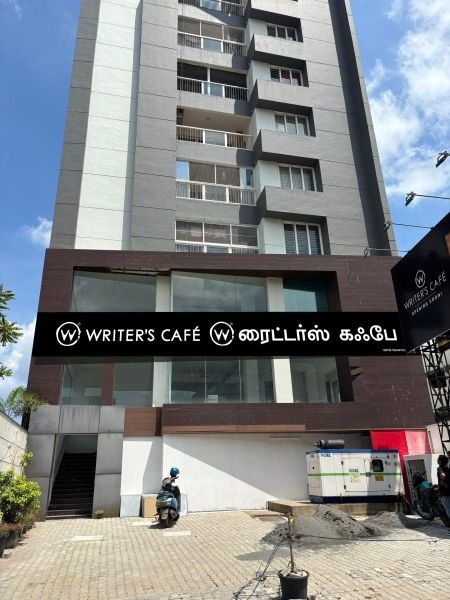
Tamil Nadu requires shop and establishment name boards to display the business name in Tamil, with the Tamil text given prominence. Bilingual boards carrying Tamil alongside English are the normal way businesses handle this, and enforcement drives happen periodically.
From a design point of view this is much easier to accommodate at artwork stage than afterwards. Tamil script has different proportions to Latin script — it needs more vertical room, and a transliterated name is often longer than the English version. Squeezing it into a layout designed around English lettering is what produces the cramped boards you see where the Tamil looks like an afterthought.
We lay out bilingual boards from the start when asked, sizing both scripts so each is comfortably readable rather than one being fitted around the other. Confirm the current requirement for your establishment type before finalising the artwork.
2. Whether your board needs an advertisement licence
Broadly, local bodies treat a name board differently from an advertisement. A board fixed flat against your own frontage, carrying your own business name, is the simplest case. The further a board moves from that description, the more likely licensing applies:
- Projecting boards — anything standing out from the building over a footpath or road
- Rooftop and high-level signage — often treated separately from frontage boards
- Pylon and totem signs — free-standing structures on your own land
- Any board carrying third-party advertising — a brand other than your own
- Digital and changing-message displays — frequently subject to additional conditions
Contact the zonal office of the Greater Chennai Corporation covering your address, or your municipality if you are outside the city limits, and describe the board you intend to put up: its size, how it fixes, whether it projects, and whether it is illuminated. That single call establishes whether a licence is needed and what it costs.
3. Your landlord's written permission
Most commercial leases restrict alterations to the exterior of a building, and a sign board is an alteration. Get permission in writing before ordering, and make sure it covers the specific thing you intend to do — a landlord who agrees to "a name board" may not have agreed to twenty fixings drilled into a new granite facade.
Where a landlord will not allow many wall penetrations, the usual answer is a raceway: a single concealed backing channel that carries all the letters and their wiring and fixes with far fewer anchor points. It also keeps alignment perfect across a long name. If you are in a mall or a managed complex, ask for the tenant signage specification early — many of them dictate maximum sizes, permitted illumination types and even mounting heights.
4. Highway and road-frontage rules
Boards close to national or state highways can fall under additional restrictions, and anything positioned where it could be confused with traffic signage — or where it could distract at speed — is treated more strictly. Red and green illumination near a junction is a recurring point of objection.
If your frontage is on a highway or a major arterial road rather than a local street, confirm the position before fabrication, particularly for pylon signs and anything free-standing near the boundary.
5. Electrical safety and the installation itself
An illuminated board is a permanent outdoor electrical installation. Whatever the licensing position, it should be built to be safe and serviceable:
- An accessible isolator, so the board can be worked on without cutting power to the shop
- Proper earthing on any metal-framed illuminated sign
- Weather-sealed cable entry — the most common route for water into a board
- A power supply rated with headroom, mounted where its heat can escape
- Fixings appropriate to the wall construction, not just to the board's weight
A practical order of operations
- Measure and photograph the frontage — including how it meets the footpath
- Ask the landlord what is permitted, and get the answer in writing
- Call the zonal office and describe the board you intend to install
- Finalise artwork with Tamil included from the start, not added afterwards
- Approve the design — late approval is the single most common cause of a missed opening date
- Fabricate and install
Steps two and three cost nothing and take a day. Skipping them is what turns a board into a board you buy twice.
Frequently Asked Questions
Does a shop name board in Tamil Nadu have to be in Tamil?
Tamil Nadu requires shop and establishment name boards to display the name in Tamil, and the Tamil text is expected to be given prominence. Bilingual boards carrying Tamil alongside English are the normal way this is handled. Enforcement drives happen periodically, so confirm the current requirement with your local authority before finalising artwork — we can lay out a bilingual board either way.
Do I need permission for a shop sign board in Chennai?
A board fixed flat on your own shop frontage is generally treated differently from a projecting board, a hoarding, or anything over a public footpath — those attract advertisement licensing from the local body. Rules and fees vary by zone and change over time, so check with your Greater Chennai Corporation zonal office, or your local municipality outside the city limits, before ordering.
Do I need my landlord's permission for a sign board?
Almost always, and in writing. Most commercial leases restrict alterations to the exterior. A landlord may also limit how the board is fixed — this is a common reason to use a raceway or an existing framework rather than drilling directly into the facade.
What happens if a sign board breaks the rules?
Typically a notice to remove or modify it, and the cost of removal falls on the business. This is why the checks are worth doing at design stage rather than after fabrication, when changes are cheap to make.
Want This Applied to Your Own Shop Front?
We survey, measure and quote free of charge across Chennai, Kanchipuram, Chengalpattu and Tiruvallur — with an itemised quotation you can compare properly against any other.
Read Next
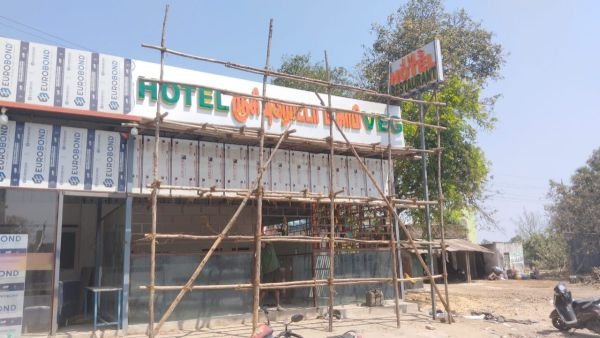
What Does a Sign Board Cost in Chennai?
Per square foot is the standard unit, but two quotes at the same rate can mean very different boards. Here is what actually sits behind the number.
Read the guide → 7 min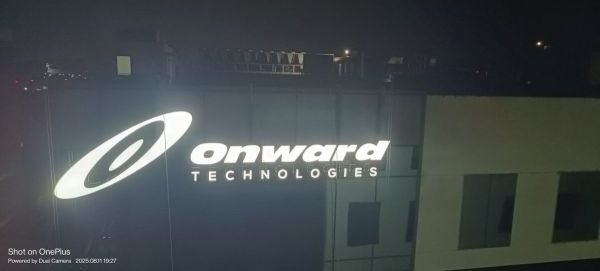
ACP, Acrylic or LED: Choosing the Right Shop Front Board
These are not competing products so much as answers to different questions. The right one depends on your trading hours, your frontage and how long the board has to last.
Read the guide → 8 min
Why Sign Boards Fail in Chennai's Climate — and How to Specify Against It
Boards here rarely fail because the face wore out. They fail at the fixings, the sealing and the power supply — all of which are invisible when you approve a quote.
Read the guide → 7 min