Why Sign Boards Fail in Chennai's Climate — and How to Specify Against It
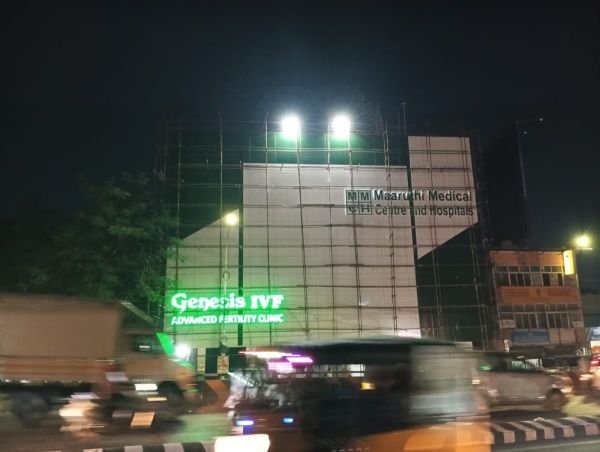
When we are called out to a failed board, the face is almost never the problem. It is the frame behind it, the seal along the top edge, or a power supply that has been running hot since the day it was fitted. Chennai's climate finds every one of those, and all three are invisible when you approve a quotation.
What the climate actually does
Three forces work on a board here, and they attack different parts of it:
- Heat — long, intense sun. Fades pigment, degrades adhesives, expands panels, and shortens the life of any electronics running without ventilation.
- Monsoon — heavy, driven rain arriving sideways. Finds any unsealed joint, and then has to be able to drain out again.
- Humid, salt-carrying air — corrodes untreated steel continuously, and much faster the closer you are to the coast.
Failure 1: the framework rusts
The most common serious failure, and the most expensive, because fixing it means taking the whole board down.
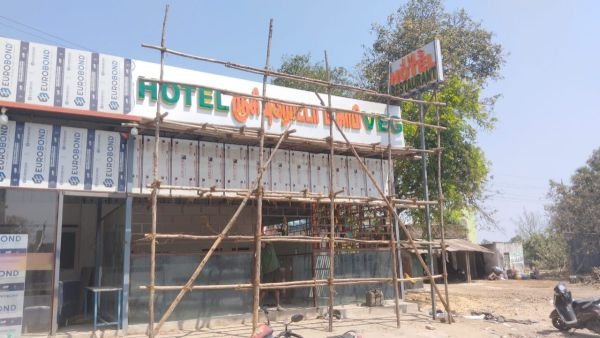
Untreated mild steel corrodes steadily in humid coastal air. For the first year or two nothing shows. Then rust bleeds through the fixing points and streaks down the front of a board that is otherwise perfectly good, and by the time it is visible the structural section has already lost material.
Specify against it: galvanised sections or aluminium for the framework, not painted mild steel. Paint over MS is a delay, not a solution — it fails first at the welds and the drilled holes, which is exactly where you need it. Within a few kilometres of the coast, stainless fixings should be 316 grade rather than the more common 304.
Failure 2: water gets in and cannot get out
Water enters an illuminated board through three routes, in roughly this order of frequency: the cable entry, an unsealed joint along the top edge, and screw holes drilled through the face during installation.
The counter-intuitive part is that sealing a board completely makes it worse. Warm humid air gets in regardless, condenses overnight, and with nowhere to go it pools at the base and sits against the electronics.
Specify against it: sealed at the top, drained at the bottom. Weep holes at the lowest points, a cable entry that enters from below or through a proper gland, and neutral cure silicone rather than acetic — the acetic type smells of vinegar as it sets, corrodes metal, and stains panel edges over time.
Failure 3: the power supply cooks
An LED module is rated for tens of thousands of hours. The power supply driving it usually is not, and it is the component that most often takes a sign dark.
Two causes, both cheap to avoid. The supply is loaded to its full rating instead of being sized with headroom, so it runs hot permanently. Or it is mounted inside a sealed enclosure in full sun with no path for its heat to escape.
Specify against it: a supply rated around 20–30% above the actual load, mounted where it can shed heat, and ideally reachable for replacement without dismantling the board. Ask where the power supply will physically sit — it is a revealing question, and a good fabricator will have an answer ready.
Failure 4: the face fades
The visible failure, and usually the least serious. What fades is decided by material choice: printed vinyl fades fastest, extruded acrylic next, and cast acrylic with UV-stable pigment holds colour for years. Flex is in a category of its own — one or two seasons before it looks tired.
South and west-facing boards take substantially more sun than north-facing ones and are worth specifying up. It is the cheapest upgrade on this list and the easiest to skip.
Failure 5: thermal movement
Panels expand in heat. On a long ACP run this is enough movement to matter, and if the fixings hold every point rigidly the panel has nowhere to go — so it buckles between fixings. The rippled, oil-canned facades you see on older buildings are almost always this.
Specify against it: fixings that allow movement, and expansion allowance designed into the panel layout rather than the sheets being pinned tight.
What to ask before you sign
Five questions. The answers tell you more about how long a board will last than any rate per square foot:
- What is the framework made of, and is it galvanised?
- Where does the cable enter the board, and how is that point sealed?
- Where does water drain from?
- What is the power supply rating compared with the actual load, and where is it mounted?
- Which way does the frontage face, and does that change what you would use for the face?
Maintenance that is actually worth doing
Very little, but the little there is matters. Once a year, and again just after the monsoon:
- Wash the face — dust films dull an illuminated board surprisingly quickly
- Check the sealant line along the top edge for gaps or lifting
- Look for staining or streaking, which usually signals a framework problem starting
- Confirm every section still lights evenly; one dark patch is a single failed module or supply
- Check the isolator still works
Replacing one power supply is a small job. Replacing a board because water sat in it for two monsoons is not.
Frequently Asked Questions
Why do sign boards rust in Chennai?
Almost always the hidden framework rather than the visible panel. Untreated mild steel behind a board corrodes in humid, salt-carrying air and the rust eventually stains down the front. Galvanised sections, or aluminium, cost more at quotation stage and are the single biggest factor in how a board looks after five years. Within a few kilometres of the coast, stainless fixings should be 316 grade rather than 304.
How does water get inside an illuminated sign board?
Usually through the cable entry, an unsealed joint on the top edge, or screw holes drilled through the face. Water tracks downward and collects at the base, so drainage holes at the bottom matter as much as sealing at the top. A board sealed completely but with no drainage traps condensation and fails faster than one that can breathe.
Do LED sign boards fade in the sun?
The LEDs themselves dim slowly and predictably. What fades visibly is usually the face: printed vinyl and extruded acrylic lose colour far faster than cast acrylic with UV-stable pigment. South and west-facing boards take the worst of it and are worth specifying up.
How often should a sign board be serviced?
A visual check once a year and a wash is enough for most boards. Worth checking after the monsoon: the sealant line along the top edge, any staining that suggests a framework problem, and whether all modules still light evenly. Catching one failed power supply is much cheaper than replacing a section of a board.
Want This Applied to Your Own Shop Front?
We survey, measure and quote free of charge across Chennai, Kanchipuram, Chengalpattu and Tiruvallur — with an itemised quotation you can compare properly against any other.
Read Next
What Does a Sign Board Cost in Chennai?
Per square foot is the standard unit, but two quotes at the same rate can mean very different boards. Here is what actually sits behind the number.
Read the guide → 7 min
Shop Sign Board Rules in Chennai: What to Check Before You Order
A board that has to come down after installation is the most expensive board there is. Five things worth confirming before fabrication starts.
Read the guide → 6 min
ACP, Acrylic or LED: Choosing the Right Shop Front Board
These are not competing products so much as answers to different questions. The right one depends on your trading hours, your frontage and how long the board has to last.
Read the guide → 8 min